

The Kottanz Promise: What Makes Every Order Special.
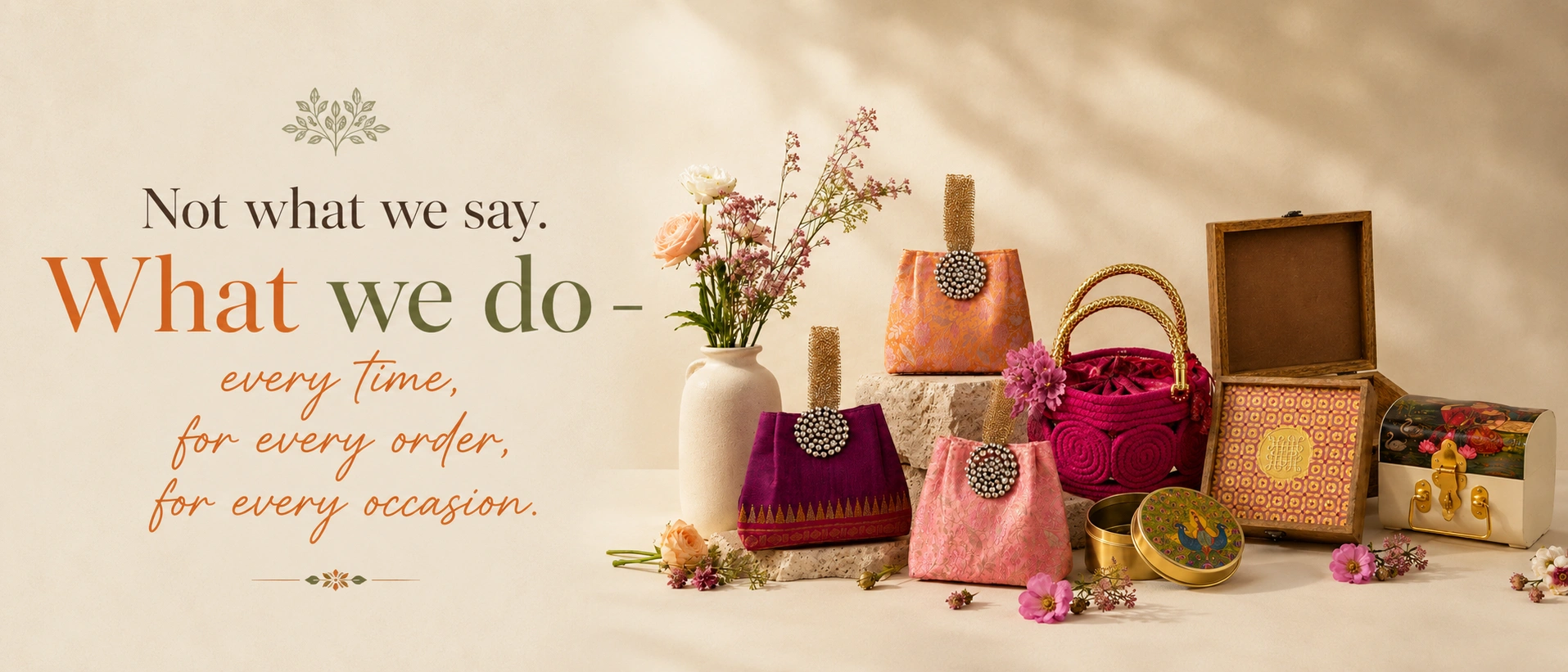
Not what we say. What we do — every time, for every order, for every occasion.
A promise is only as good as the product it arrives in.
Every brand makes promises. Handcrafted. Premium. Authentic. The words are everywhere, and they have been repeated so often that they have stopped meaning much. What matters is not what a brand says — it is what the customer holds in their hands when the order arrives, and whether it matches what they were told to expect.
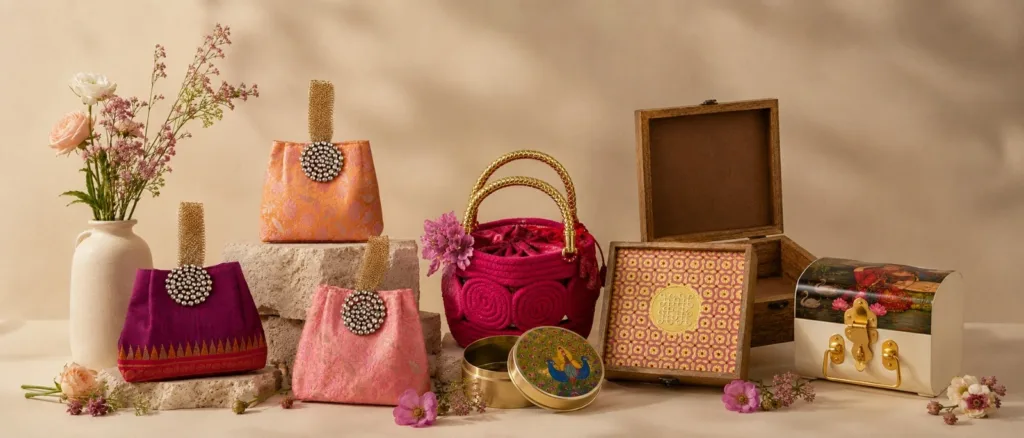
The Kottanz promise is not a tagline. It is a set of specific commitments that run through every product in the catalogue — from the orange brocade wristlet bag to the meenakari trunk box to the handwoven jute basket to the filter kaapi hamper. Each one is made a particular way, from particular materials, by particular people. That specificity is the promise. Here is what it looks like in practice.
One: Every Product Is Made by Hand — Actually.
Not assembled by machine and finished by hand. Not printed to look handmade. Made by hand, from the first cut of fabric to the last setting of a crystal embellishment, from the first row of woven jute to the final painted detail on a meenakari surface. The Mangalgiri wristlet is stitched by a tailor working from Andhra Pradesh cotton. The meenakari trunk is painted by an artisan in a craft tradition that has been passed down for generations. The jute basket is coiled and bound by hand, one ring at a time. This matters because handmade objects are not uniform. The crystal embellishment sits at a marginally different angle on each bag. The meenakari pattern has a slightly different density of detail on each trunk. The jute weave has a texture that shifts across the surface. These are not defects. They are the evidence of the thing being real.
Two: The Materials Are Always Natural.
Brocade is woven silk and metallic thread — a real textile with centuries of Indian history behind it. Mangalgiri cotton is grown and woven in Andhra Pradesh by communities whose livelihood depends on the craft. Jute is one of India’s most sustainable natural fibres, biodegradable and strong. The meenakari surface is enamel on metal, not printed vinyl. The brass tumbler in the filter kaapi hamper is cast brass, not plated steel. Kottanz does not use synthetic alternatives where natural materials exist. This adds cost, adds complexity, and adds the kind of quality that lasts. A brass tumbler used daily for a year looks better than the day it arrived. A Mangalgiri bag that goes to ten temple visits develops a particular softness that synthetic fabric never achieves. Natural materials age into themselves. That is part of what the customer is buying.
One Brand. Every Occasion Covered.
Three: The Range Is Genuinely Wide.
The customer who comes to Kottanz for a wedding return gift and finds the wristlet bag returns six months later for a housewarming and finds the meenakari tray. They come back for Diwali and find the filter kaapi hamper and the chai hamper. They plan a corporate gifting order and find the jute basket collection. This is not an accident. The catalogue was built to cover the Indian gifting calendar completely — not to specialise in one format, but to be the answer to every occasion a customer brings.
The meenakari trunk box sits on a dressing table and holds jewellery. The rope basket with velvet potli becomes a kitchen organiser. The Mangalgiri wristlet goes from wedding return gift to everyday bag. The filter kaapi hamper becomes the morning ritual of the household that receives it. Every Kottanz product has a use that extends beyond the occasion it was given for — and that extended usefulness is what makes customers return.
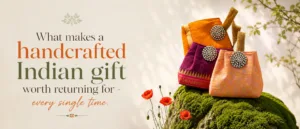
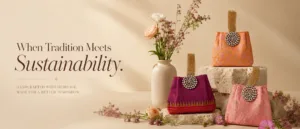
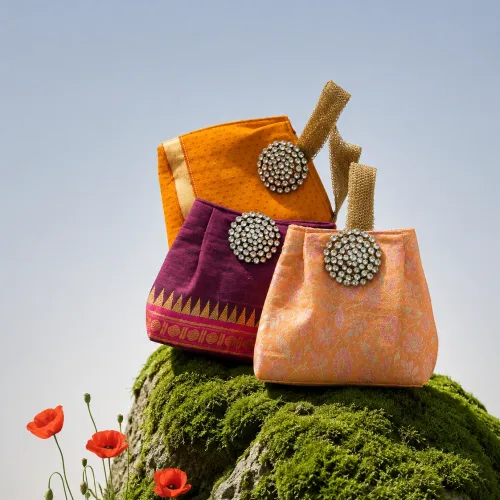
◆ Wristlet Bags — Brocade and Mangalgiri cotton — orange, purple, pink, peach. Gold mesh handle, crystal embellishment. Wedding and festive return gifts that guests wear beyond the day.
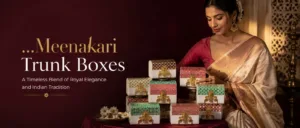
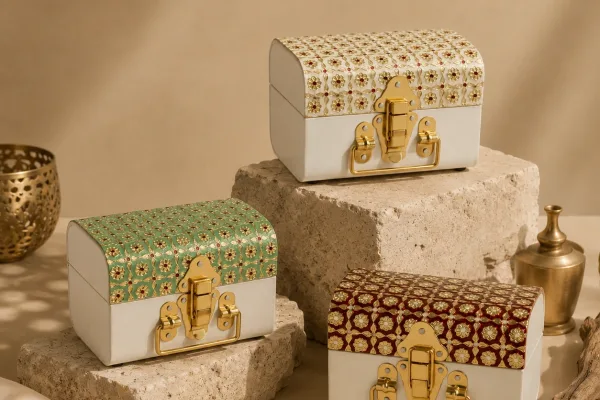
◆ Meenakari Trunk Box — Hand-painted domed keepsake box in ivory, emerald, and maroon. Gold clasp. A gift that becomes a permanent fixture on a dressing table.
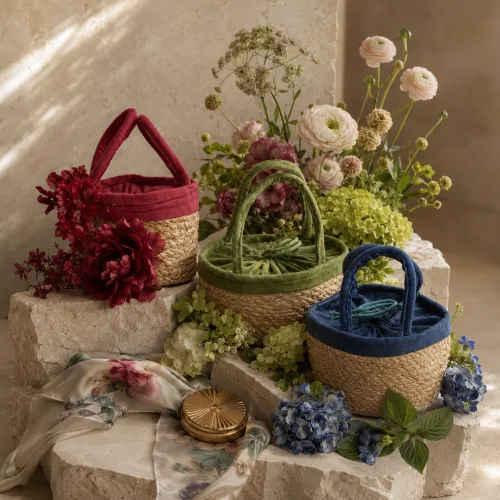
◆ Jute Basket with Potli — Handwoven natural jute paired with a velvet drawstring potli in blue, crimson, or green. Fully reusable. The eco-friendly return gift that holds its own after the occasion.
◆ Rope Basket with Velvet Potli — Coiled natural fibre basket with padded velvet handle. A return gift for baby showers, housewarmings, and Seemantham ceremonies that becomes a storage object.
◆ Meenakari Serving Tray — Wooden tray with hand-finished meenakari base in green or red. A daily-use object that earns its place on every dining table it lands on.
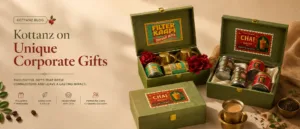
◆ Filter Kaapi Hamper — Brass tumbler-davara set, filter coffee tins, olive velvet keepsake box. A gift built around one of South India’s oldest morning rituals.
◆ Chai Hamper — Meenakari serving glasses, masala chai tins, olive velvet box. The gift for the home that runs on tea — which is most of India.
Made with Care. Given with Intention.
Four: Every Product Supports Indian Craft Communities.
Brocade weaving is formally recognised by the Office of the Development Commissioner for Handicrafts as one of India’s most significant traditional textile art forms. Mangalgiri cotton is produced by weaving communities in Guntur district whose craft identity is inseparable from their livelihood. Meenakari is a Rajasthani craft tradition sustained by families who have practised it for generations. Jute weaving is championed by the National Jute Board as a critical rural artisan industry.
When a customer orders from Kottanz, they are not only solving a gifting problem. They are contributing to the continuation of these craft economies. This is not a cause that Kottanz has added to its marketing — it is the structural reality of where and how the products are made. The craft communities exist because people buy the objects. The objects are worth buying because the craft communities keep the quality high. This is the loop that Kottanz is built within.
Five: The Packaging Is Part of the Gift.
The filter kaapi hamper arrives in an olive green velvet keepsake box with a brass latch and a vintage-inspired label. The chai hamper arrives in the same box. The meenakari trunk box is its own packaging — there is nothing to unwrap because the box is the gift. The jute basket is its own carrier. The rope basket arrives ready to receive whatever the host chooses to put inside it.
Kottanz does not add foam inserts and printed ribbon to make a product look premium. The products are built to present themselves. The packaging is not disposable because it is part of what the customer is giving. When a guest receives a Kottanz return gift, the first impression is formed before the contents are touched — and that impression holds.
Six: Sustainable Gifting Without Sacrifice.
The persistent assumption in Indian gifting is that the eco-friendly option is the lesser option. Kottanz disproves this across the catalogue. Natural jute is stronger than synthetic basket weave and biodegradable. Mangalgiri cotton is more breathable and more durable than polyester. Brass outlasts stainless steel in terms of ageing. Meenakari enamel is more durable than printed decoration. Every sustainable choice in the Kottanz catalogue is also the higher-quality choice — and that is not a coincidence. It is a design principle.
Heritage. Handcrafted. Here.
Seven: No Two Pieces Are Identical — and That Is the Point.
Mass production guarantees uniformity. Handcraft guarantees variation. Every Kottanz wristlet bag has its crystal embellishment set at a slightly different angle. Every meenakari trunk has a pattern with marginally different spacing. Every jute basket has a weave texture that is its own. These variations are not quality failures — they are the proof of human involvement. A return gift that is one of a kind is a return gift that the guest cannot find an identical copy of anywhere else. That exclusivity is not an accident. It is what handcraft produces.
Eight: The Gift Experience Reflects the Occasion.
A wedding return gift table communicates something about the family giving the gifts. A corporate gifting order communicates something about the company sending it. A Seemantham return gift communicates something about the hosts and the significance they placed on the occasion. Kottanz products are chosen by hosts who understand this. The meenakari trunk says: we thought about what you would keep. The wristlet bag says: we chose something you would use. The filter kaapi hamper says: we gave you something rooted in culture, not convenience. The Kottanz promise is not a single statement. It is the sum of every decision made in every product — the material chosen, the craft tradition drawn from, the finish applied, the packaging designed, the occasion considered. When a customer receives a Kottanz order, all of those decisions arrive with it. That is what makes every order special. Not the box. Not the label. The work behind it.