

Beyond Ceramic. Why Brass Diffusers Are Changing the Way We Think About Home Fragrance.
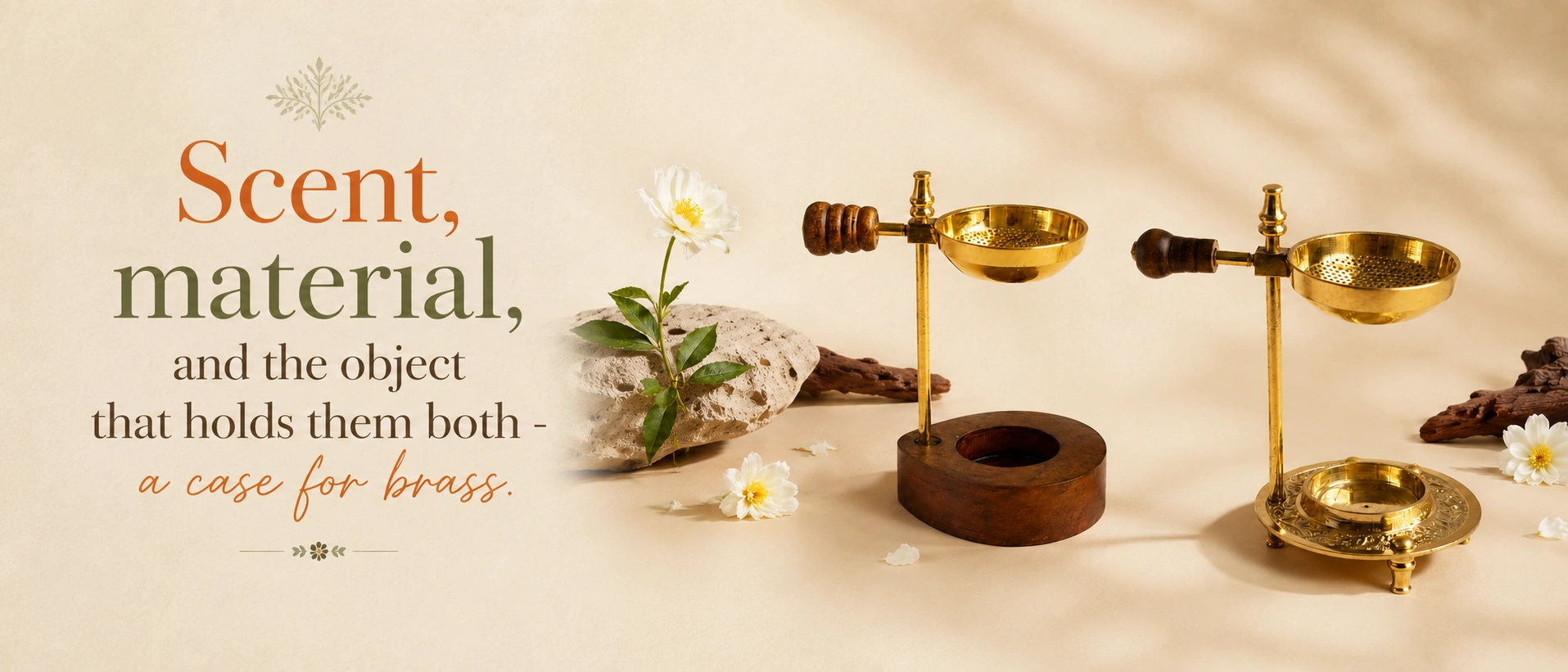
Scent, material, and the object that holds them both — a case for brass.
Brass Diffuser Collection · Wood-base and all-brass variants · Kottanz
There is a specific quality that the best home objects share: they are noticed every time they are picked up, and missed when they are not in the room. The ceramic diffuser was never built to that standard — it was built to be useful and unobtrusive, to do its job without asking for attention. For a long time, that was enough.
It is no longer enough. The homes being built and curated today are asking more of the objects inside them. Not just function. Not just neutrality. Actual presence — the kind that comes from material, from weight, from the knowledge that something was made by hand with a specific intention. Brass carries all of that. It always has. The only thing that has changed is the room it is being placed in.
This is not a new object. India has had it for centuries.
Before electric diffusers, before ultrasonic misters, before scented candles arrived in imported tins — Indian homes had the camphor diffuser. A perforated brass bowl suspended over a heat source, releasing camphor, sambrani, or resin slowly and completely into a room. This was the fragrance technology of temples, of prayer rooms, of every South Indian household that understood that scent was not a luxury add-on but a fundamental part of how a home feels.
The traditional camphor diffuser has never disappeared from Indian life. It has simply been waiting for the rest of the market to catch up to what it always was: a considered, functional, genuinely beautiful object that does exactly what it promises without needing electricity, a subscription, or a replacement cartridge.
Kottanz has taken that form — unchanged in principle, refined in proportion and finish — and placed it where it has always deserved to be: at the centre of a modern home that knows its own taste.
The traditional camphor diffuser has been in Indian homes for centuries. It never needed to be reinvented. Only recognised.
Then Why Does Everyone Still Buy Ceramic?
Walk through any home fragrance aisle and you will find the same object in a hundred variations: a white ceramic vessel, matte finish, designed to disappear into a shelf. It does its job. It asks for nothing. It offers nothing either. The ceramic diffuser won the market not because it was the best object for the task but because it was the easiest to manufacture, the most neutral to style around, and the least likely to polarise. That is a logistics argument, not a design one. And it is not a good enough reason to keep choosing it when the traditional camphor diffuser — in brass, weighted, warm, alive in light — is sitting right there asking to be picked up instead.
Brass doesn’t try to disappear. It earns its place in a room by being exactly what it is.
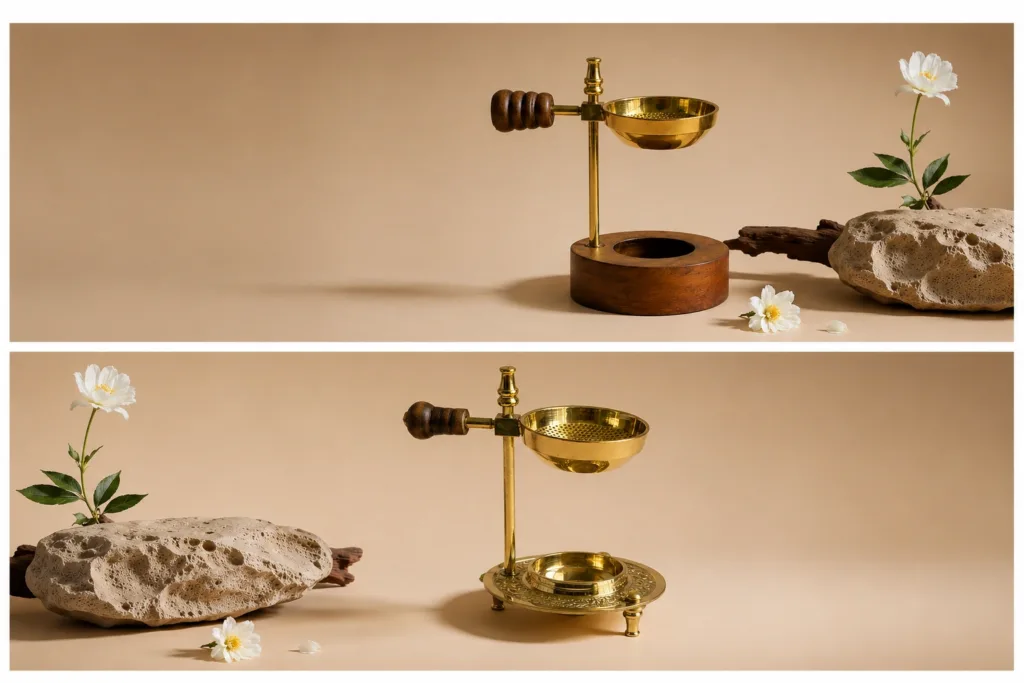
Wood base. Brass base. The same conviction, two different rooms.
How They Work
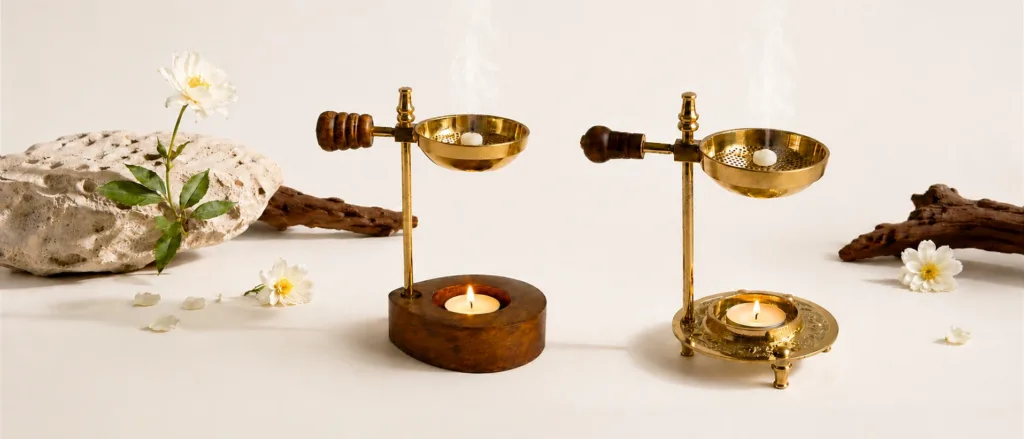
Both diffusers use the same principle that Indian households have relied on for centuries: a tealight below, a perforated brass bowl above, and whatever you place in that bowl — camphor, sambrani, essential oils, beeswax melts, dry florals — releasing its scent slowly and completely as the heat rises through the latticed base. No electricity. No ultrasonic hum. No refill cartridges. Just heat, metal, and scent.
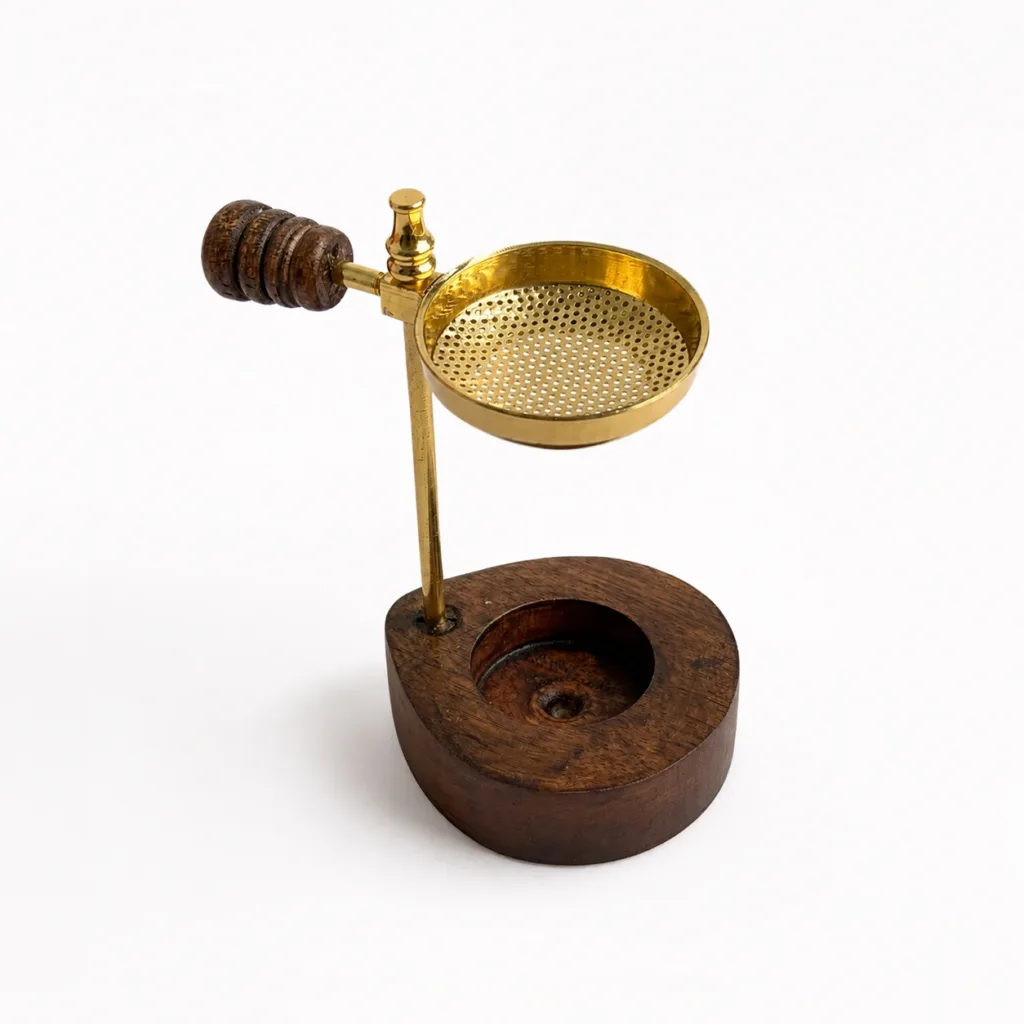
The perforated brass bowl is not decorative — it is structural to the diffusion. The lattice distributes heat evenly, preventing hot spots, allowing the camphor or oil in the bowl to release at a consistent, gentle rate rather than burning off quickly. The result is a fragrance that fills a room gradually and stays.
What Goes in the Bowl
◆ Camphor — The most traditional use. One or two pieces of camphor release a clean, sharp, sacred fragrance that clears a room instantly. This is how temples have always smelled.
◆ Sambrani — Benzoin resin that releases a warm, woody, slightly sweet smoke when heated. Used in South Indian homes for centuries as a purifier and a fragrance.
◆ Essential oils — A few drops of any oil — eucalyptus, sandalwood, lavender — and the brass bowl does the rest.
◆ Wax melts — Any scented wax placed in the bowl will melt slowly over the tealight and release its fragrance for hours.
Why the base is the whole decision.
The Wood-Base Diffuser
The wood-base variant grounds the brass in something warmer. A solid turned-wood disc holds the tealight below while the brass rod, cross-arm, and perforated bowl rise from it — a combination of materials that reads as considered rather than collected. The dark wood absorbs light; the brass reflects it. Together they occupy a room with a quiet authority that all-metal objects sometimes miss.
This is the traditional camphor diffuser reinterpreted for the living room, the reading corner, and the bedroom — spaces where warmth matters as much as beauty. The wood base also makes it the more approachable of the two: it sits easily on a wooden shelf or a cane tray without demanding a considered backdrop.
The All-Brass Diffuser
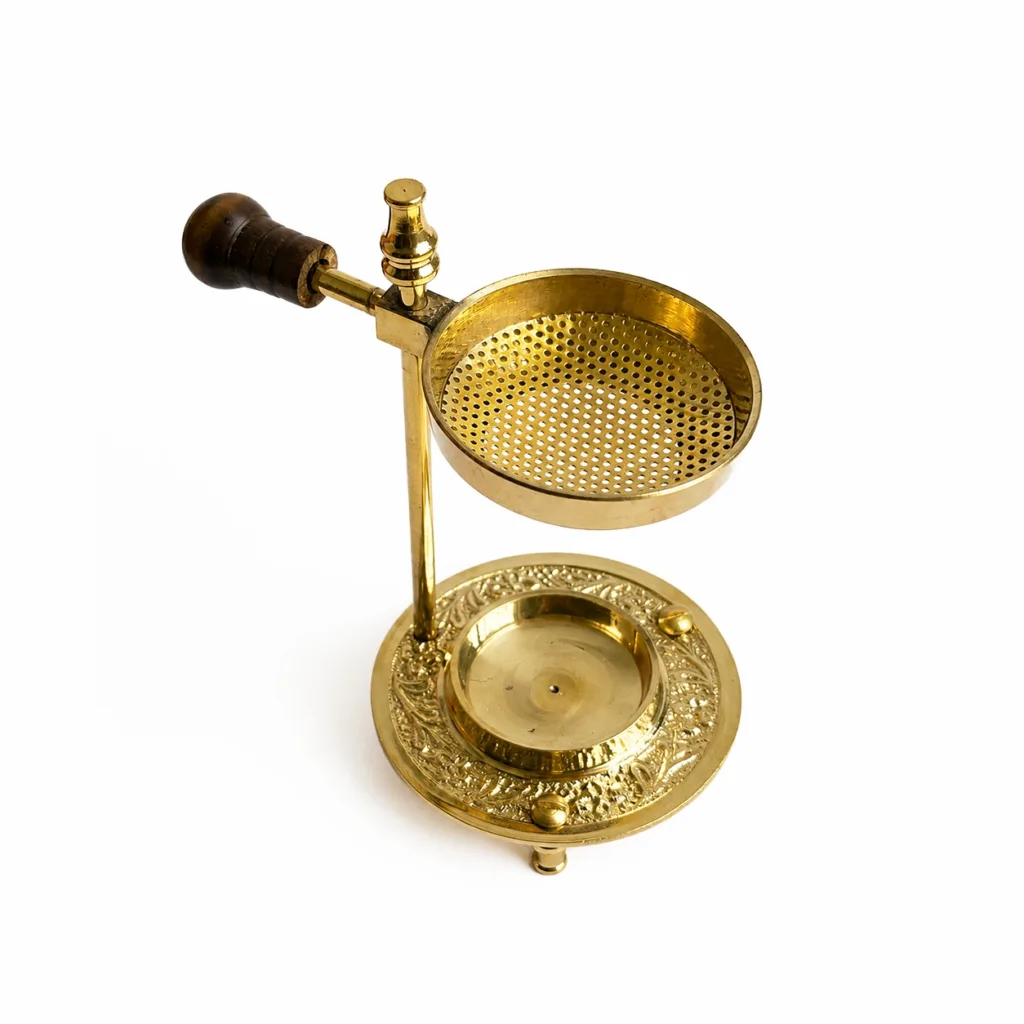
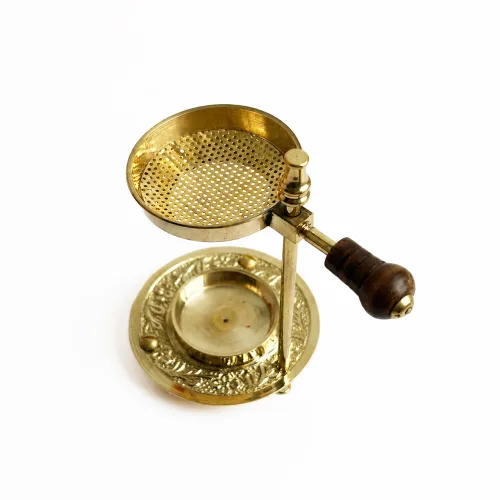
The all-brass variant makes no concession to softness. Brass base plate with embossed border, brass feet, brass rod, brass bowl — the entire object is one material and one colour, and that consistency is its entire aesthetic argument. It reads like something that belongs in a collection, on a puja shelf, or in a home that understands that gold is not excessive — it is Indian.
The embossed base plate doubles as a catch tray and as the visual anchor of the object. Where the wood-base diffuser draws you upward, the all-brass version spreads outward, wider and more grounded. On a puja space or a dedicated fragrance corner, it is the version that announces itself correctly.
Two bases. Two moods. One thing they share: no room forgets them.
The object that holds the scent should be worth looking at after the candle goes out.
Where It Belongs
◆ Living room — A surface piece that works as sculpture and as diffuser equally.
◆ Bedroom — Low, warm fragrance without the hum of an electric device.
◆ Puja space — Camphor and sambrani released slowly through brass, the way it has always been done.
◆ Office desk — The one object on the desk that people ask about.
◆ Gift — Housewarming, Diwali, or any occasion where you want to give something genuinely considered.
Why Brass, and Why Now
Brass has been the material of Indian ritual objects for thousands of years — diyas, puja thalis, incense holders, water vessels. It is not a trend that arrived from a Scandinavian design studio or a Brooklyn lifestyle brand. It is a material with a deep, unbroken history of being used for the objects that matter most in Indian domestic life. The contemporary moment for brass is not a rediscovery.
It is a recognition — by a generation of Indian consumers who have stopped treating their own material tradition as secondary to imported aesthetics, and started placing it exactly where it belongs: at the centre of a considered home.